
Exploring Python’s Role in Advanced Technologies

Python has emerged as a dominant force in the realm of machine learning, offering a rich ecosystem that caters to both novices and experts in the field. Its popularity stems from several strengths that make it an ideal choice for machine learning applications.
Firstly, Python’s simplicity and readability play a pivotal role in its widespread adoption. The language’s clear and straightforward syntax allows for easy comprehension, making it accessible to beginners and facilitating rapid prototyping. This simplicity aids in quick experimentation, fostering an environment where ideas can be easily translated into code.
Moreover, Python boasts an extensive selection of powerful libraries and frameworks specifically designed for machine learning and data science. The most notable among these is TensorFlow, developed by Google, and PyTorch, sponsored by Facebook’s AI Research lab. These libraries offer a plethora of tools and functionalities, enabling developers to build and train complex neural networks and models efficiently. Additionally, scikit-learn provides a user-friendly interface for various machine learning algorithms, making it an excellent choice for classical machine learning tasks.
Another strength of Python is its thriving community support. The abundance of online resources, forums, and tutorials empowers both newcomers and experienced practitioners. This community-driven support system contributes to the continuous evolution and enhancement of machine learning tools and practices, ensuring that developers have access to the latest advancements and best practices.
Furthermore, Python’s versatility plays a significant role in its prominence in the machine learning domain. It seamlessly integrates with other languages and tools, facilitating the development of complete end-to-end solutions. From data preprocessing to model deployment, Python offers a comprehensive ecosystem that covers every aspect of the machine learning workflow.
Additionally, the language’s scalability and performance have significantly improved over the years. With optimizations and the ability to leverage parallel processing and distributed computing, Python has become more adept at handling large-scale machine learning tasks.
In conclusion, Python’s strengths in machine learning lie in its simplicity, extensive libraries, community support, versatility, and evolving performance capabilities. These factors collectively contribute to Python’s standing as the preferred language for machine learning applications, fostering innovation and driving advancements in this ever-evolving field.
For more information on how Python continues to push Machine Learning capabilities forward, please see the resource accompanying this post.
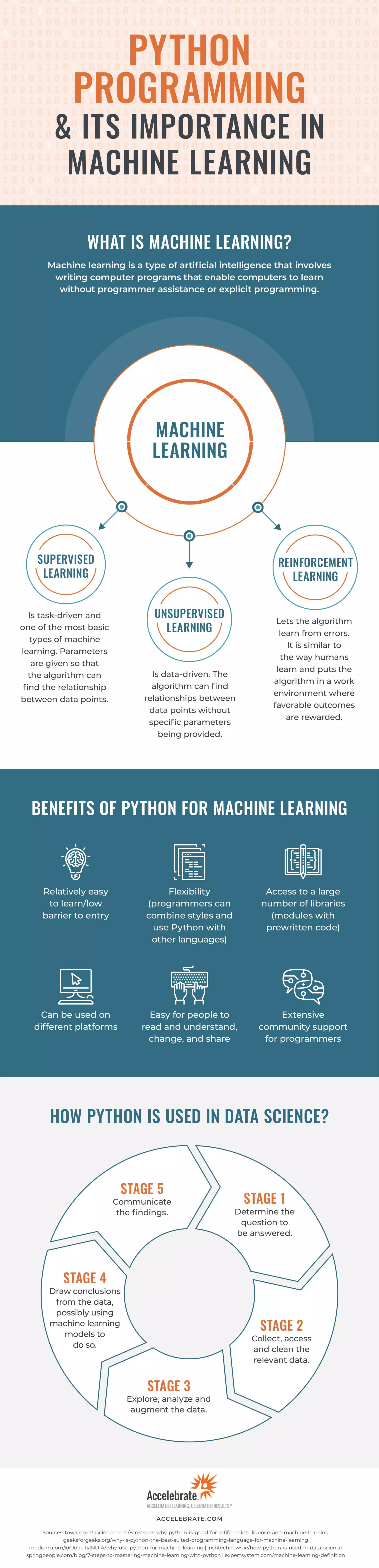
Python Programming & Its Importance In Machine Learning provided by Accelebrate, a company offering courses in Python Data Science training